Services

Full Growth System Creative Strategy Creative Development Paid Media Management How It Works Results About Talk to Us

service · creative strategy

Find the customer territory your current creative is missing.

BrightCircle turns customer evidence into a testing roadmap and build-ready briefs, with the first briefs arriving within ten business days. Surveys and customer conversations sharpen the strategy across the three-month cycle.

$5,000/month
3-month strategy cycle
Check fit for Creative Strategy

More creative does not help when every brief starts from the same assumption.

The account is active, but every concept returns to the buyer the brand already understands and the value proposition that already worked. Acquisition costs rise, the same few winners carry the account, and production becomes new formats around old ideas.

BrightCircle finds the customer groups, purchase drivers, objections, and use cases the account has not fully addressed, then turns them into a prioritized testing plan.

message test · audio brand

Same product. Same format. Different reason to buy.
CPA fell 47%.

BrightCircle changed the message from product-led functional claims to segment-led emotional value while the product, static format, media team, and account stayed the same. The new statics ran at a 47% lower CPA than the account average.

Read the message-only case →
Survey chart showing customers selecting the segment that describes them
A customer survey in field, with buyers picking the segment that describes them.
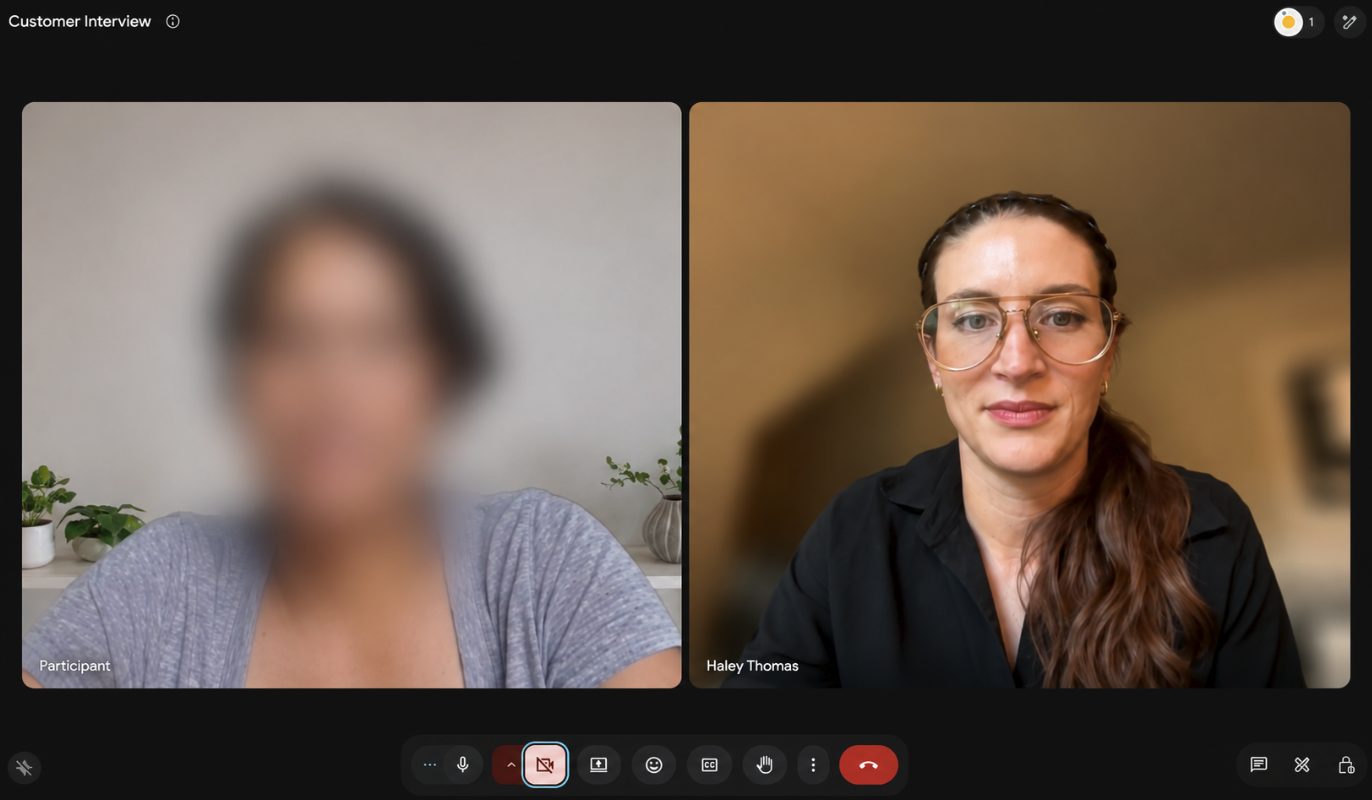
Customer conversation in progress, participant anonymous
A customer conversation in progress.

Useful work starts before the research is finished.

first 10 business days

  • Build the first Brand Canon from positioning, claims, product context, creative history, and current customer language. The Brand Canon holds what the brand stands for, who it serves, and why customers buy. Every brief gets written against it, and it changes when the customer evidence does.
  • Audit reviews, ad comments, competitors, account performance, and where the advertising repeats itself
  • Identify the first segment hypotheses and deliver build-ready briefs

When Creative Development or Paid Media is included, the first tests can begin while deeper research continues. Strategy-only clients receive the same briefs and a clear handoff.

The strategy sharpens across a three-month evidence cycle.

month 1 · build the hypotheses

Use existing evidence to understand what the brand says today, why buyers appear to respond, where the account is concentrated, and what questions remain.

Output: Initial Brand Canon, message map, segment hypotheses, first briefs, and survey design.

month 2 · ask the customer directly

Field and analyze a survey built around the unanswered purchase questions. Use the response to validate, revise, or replace the early hypotheses.

Output: Refined segments, purchase drivers, survey findings, updated message territory, and the next brief queue.

month 3 · go deeper where the evidence requires it

Use targeted customer conversations to understand fears, certainty, doubts, alternatives, and the language buyers use to describe the outcome. The scope follows the questions the earlier work leaves open.

This is where the fears and doubts get a human voice. A segment stops being a data point and starts sounding like a person, which is what makes the creative land.

Output: Customer verbatims, a refined segment model, the prioritized 90-day testing roadmap, and the next set of briefs.

Account results continue to update the strategy after the first cycle ends.

what the team receives

Documents your team can actually build from.

It works whether we build the creative, your team does, or another agency does.

  • Build-ready creative briefs
  • Segment model and purchase drivers
  • Funnel Messaging Matrix and prioritized 90-day roadmap
  • Review, ad-comment, competitor, and survey synthesis
  • Customer conversation synthesis and verbatims
  • Brand Canon and customer evidence library

Every angle in the brief traces back to something a customer said.

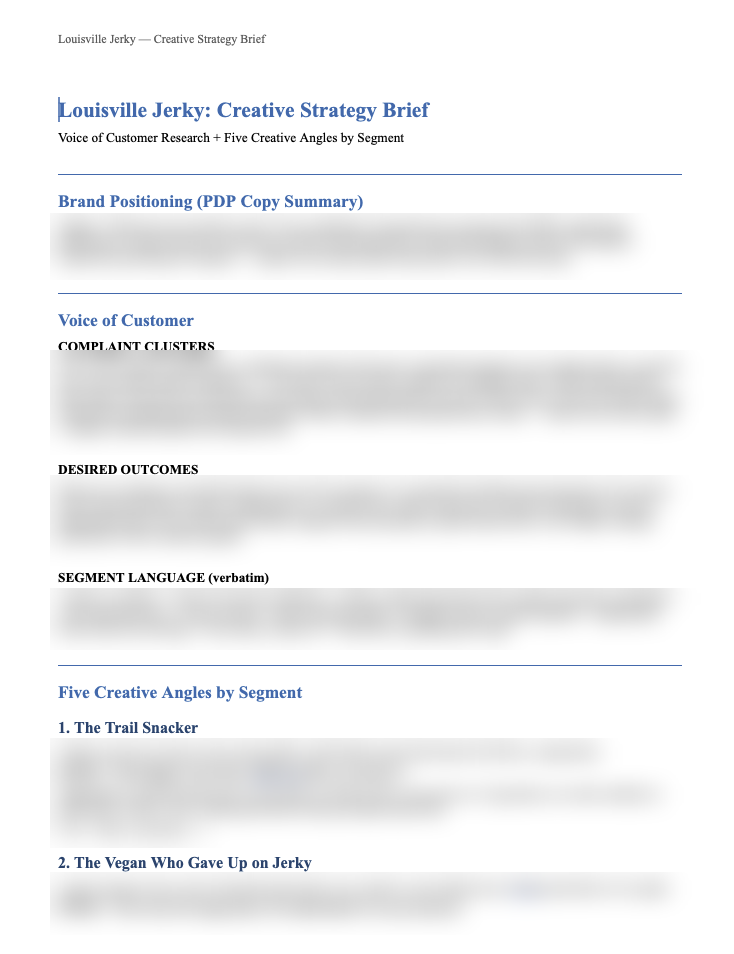
The Louisville Jerky Co. brief runs on voice-of-customer research: complaint clusters, desired outcomes, and the language each segment uses, quoted verbatim. Five creative angles come out of it, each tied to a named segment like The Trail Snacker or The Vegan Who Gave Up on Jerky. A designer or creator can start from it the day it arrives, and whoever runs your account can see the evidence behind every angle.

Creative Strategy Brief for Louisville Jerky Co., showing voice-of-customer research and five creative angles by segment
Voice-of-customer research and five creative angles, one per customer segment.

the method

Stack new customer segments on top of what already works.

TAM Stacking means keeping the messages that already perform while adding distinct reasons for the next customer group to care.

Sean developed the segmentation discipline behind the method while helping scale Vari past $300 million in annual revenue. The business expanded from an initial back-pain use case into runners, business travelers, health-conscious consumers, active-workspace buyers, and other groups without abandoning the base that created the first stage of growth.

The Funnel Messaging Matrix maps buyer states against message territory, then shows where spend, conversion volume, and acquisition efficiency are concentrated. The team uses it to rank the next hypotheses against customer evidence and account economics.

See the full learning loop →

the Funnel Messaging Matrix

Most brands only scratch the surface of what a segment needs to hear.

None of this is about format. Change the template, the hook, or the edit and you can still be making the same argument to the same person. The grid works one level down, on the belief each ad asks someone to accept.

The rows are what the customer already knows. The columns are how the ad persuades. Every brief we write is one cell: a specific customer, a specific argument.

Row = what they know
Col = the job

PEProblem EducationThe tension is doing the persuading.
PCProduct CaseThe product itself is doing the persuading.
BSBrand StoryBrand meaning is doing the persuading.
PRProofValidation is doing the persuading.
OFOfferThe deal is doing the persuading.
Row 1Cold"Assume nothing."They don't know the category is any good, and they don't know you. Earn relevance from zero.
1–PE

Name the pain cold. Dramatize the frustration a first-timer feels before they've heard of you. The itch that stops the scroll.

1–PC

Introduce the product as the fix. Lead with the single most craveable feature or benefit, assuming no prior context.

1–BS

The first handshake. The one piece of your origin or mission that makes a total stranger care who you are.

1–PR

First-timer validation. A reaction, demo, or bit of buzz that proves to someone who has never heard of you that the product is real.

1–OF

Low-risk entry deal. The offer that makes a first try feel safe: starter size, first-order discount, free shipping.

Row 2Comparing"They know the category, not you."They're already weighing options. Win the comparison against what they use now.
2–PE

The alternative is the problem. Show what is wrong with what they reach for now, to someone already shopping the category.

2–PC

Win the head-to-head. The specific features where you clearly beat the alternative they are weighing.

2–BS

Not like the others. The part of your story that separates you from the tired, mass-market default.

2–PR

Side-by-side proof. Validation against what they usually buy: the taste test or comparison that tips the decision.

2–OF

Smarter-value deal. The offer that makes you the better-value pick versus the alternative.

Row 3Familiar"Assume they know you."They're already in your world. Deepen the relationship or reactivate a past buyer.
3–PE

Re-raise a problem for insiders. A reason to come back: running low, rationing a favorite.

Often a gap
3–PC

News for people who know you. "It's back," a new variant, leaning on products they already recognize.

3–BS

Deepen the world. Culture, lore, community, or behind-the-scenes for people already in your orbit.

3–PR

Proof aimed at fans. Validation that trades on familiarity: returning creators, fan reactions, "you asked, they answered."

3–OF

Reactivation deal. Restock, drop, loyalty, or fan-favorite return that pulls past buyers back.

Scroll the grid sideways to see every column →

Problem Education Product Case Brand Story Proof Offer

One grid per segment. Every brief we write points at a specific cell.

Check fit for Creative Strategy.

Bring the account and the customer questions growth keeps returning to. We will determine whether strategy is the constraint and what the first quarter should answer.

A member of the team will review the account and reply with the best starting point.